
From Tycho Brahe to Beijing: Jesuit Instruments at the Qing Observatory
By Xiaona Wang, University of Warwick, UK
A SIS Grant supports this research. A longer piece on this subject will feature in a future SIS Bulletin.
When I began my SIS-supported research on Jesuit scientific instruments in late imperial China, I wanted to know what happened when European astronomical instruments entered a very different courtly and intellectual world. My research visit in spring 2026 took me to the Beijing Ancient Observatory, the Palace Museum, and Tsinghua University Museum, where I examined surviving instruments associated with the Jesuit missions between 1600 and 1800.
The central figure in this story is Ferdinand Verbiest (1623–1688), a Flemish Jesuit missionary from Pittem, in present-day Belgium. He joined the Society of Jesus in 1641 and arrived in Macau in 1658, later moving to Beijing in 1660 to assist Adam Schall von Bell with calendar reform. During the calendar controversy of the 1660s, Verbiest defended European astronomical methods against their critics. In a public astronomical contest before the Kangxi Emperor, he demonstrated that European methods could predict the length of a gnomon’s shadow more accurately than traditional Chinese calculations. This victory restored Jesuit influence at court and led to his appointment as Director of the Imperial Astronomical Bureau in Beijing.
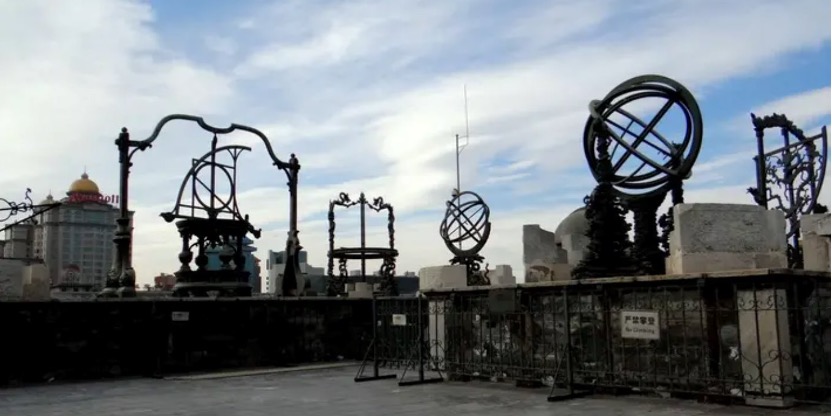
From 1669 to 1673, Verbiest supervised the construction of six new bronze astronomical instruments for the Beijing Observatory. This was not a solitary achievement: the project involved other Jesuit astronomers, including Filippo Grimaldi and Tomás Pereira who arrived in Beijing in the early 1670s, as well as Chinese craftsmen and officials responsible for much of the casting and construction. Together they produced six large instruments: an equatorial armillary sphere, an ecliptic armillary sphere, a celestial globe, an azimuthal instrument, a quadrant, and a sextant.
These instruments are often described as ‘copies’ of Tycho Brahe’s designs. Tycho’s Mechanica (1598) was certainly the key source, and Verbiest’s Astronomia Europaea (1687) presented the new instruments to European readers. But seeing the objects up close makes simple labels like ‘copy’ or ‘transfer’ unsatisfying. The Beijing instruments have their own material presence: bronze castings, engraved scales, and elaborate mounts with dragons and lions that connect astronomy to imperial authority. Their design follows European geometrical principles, yet their execution and meaning belong to the Qing court.
My visit also raised larger questions. How were these instruments used in calendrical reform, imperial ritual, and the legitimation of Jesuit astronomy? How did later French Jesuit mathematicians connect Beijing with the Paris Observatory and the Académie des Sciences, including in debates over the shape of the Earth? And how did the material and numerical knowledge gathered in China circulate beyond the Qing court?
The SIS grant allowed me to study these instruments as physical objects rather than illustrations. I looked closely at inscriptions, construction, and display histories, and compared them with European printed designs and surviving instruments. The preliminary picture is one of translation rather than passive adoption: European instrument-making traditions were adapted, re-made, and re-signified in China, while Chinese observations and data entered European scientific debates. I am grateful to the Scientific Instrument Society for supporting this research, and to the curators and staff at the Beijing Ancient Observatory, the Palace Museum, and Tsinghua University Museum for their generous assistance.
Further Reading
1. Tycho Brahe, Astronomiae instauratae mechanica (Wandsbek, 1598).
2. Ferdinand Verbiest, Xinzhi Lingtai Yixiang Zhi 新製靈臺儀象志 (Beijing, 1674).
3. Ferdinand Verbiest, Astronomia Europaea (Dillingen, 1687).
4. Noël Golvers, The Astronomia Europaea of Ferdinand Verbiest, S.J. (Dillingen, 1687): Text, Translation, Notes and Commentaries (Nettetal, 1993).