
Space Age Lunar Globes in Vienna
By Luís Tirapicos
A SIS Grant supports this research. A longer piece on this subject will feature in a future SIS Bulletin.
In the early spring of 2025, with the generous support of the Scientific Instrument Society Grant Scheme, I had the opportunity to visit and research the unique and extraordinary collection of the Globe Museum (GM), in Vienna. The GM is one of the five Museums of the Austrian National Library and the only specialised institution combining the acquisition, collection and exhibition of historical globes. It was established in 1953 and opened its doors, with 75 objects, in 1956. With around 800 items currently – terrestrial and celestial globes, spheres of the moon and planets, armillary spheres, planetaria, telluria and lunaria – it holds the largest globe collection in the world on public display.[1]
My focus was the collection of lunar and planetary globes; it comprises approximately 75 pieces, including 50 objects that originally were assembled in the former private collection of the German cartographer Dr. Karl Heinz Meine.[2] However, my main purpose was to produce a preliminary study on the history and evolution of lunar globes made after the advent of the Space Age, during and after the Cold War.
Among the several gems of the collection in Vienna, I want to highlight the first Soviet globe displaying parts of the then unknown far side of the Moon, currently on display at the GM. This lunar globe was produced in 1961 based on telescopic photographs for the near side and Luna 3 photography obtained in October 1959 for the far side. The region between 90º W and 160º W, on the far side – not yet covered photographically in detail by Soviet probes and unknown at that time – remained blank. With a diameter of 25.8 cm this globe was issued in Moscow by the Central Scientific Research Institute for Geodesics, Aerophotography and Cartography and the P. K. Sternberg Institute. In 1963 a similar but larger version (33 cm diameter) was published by Verlag Paul Räth Nachf. KG, in Leipzig, East Germany.[3]
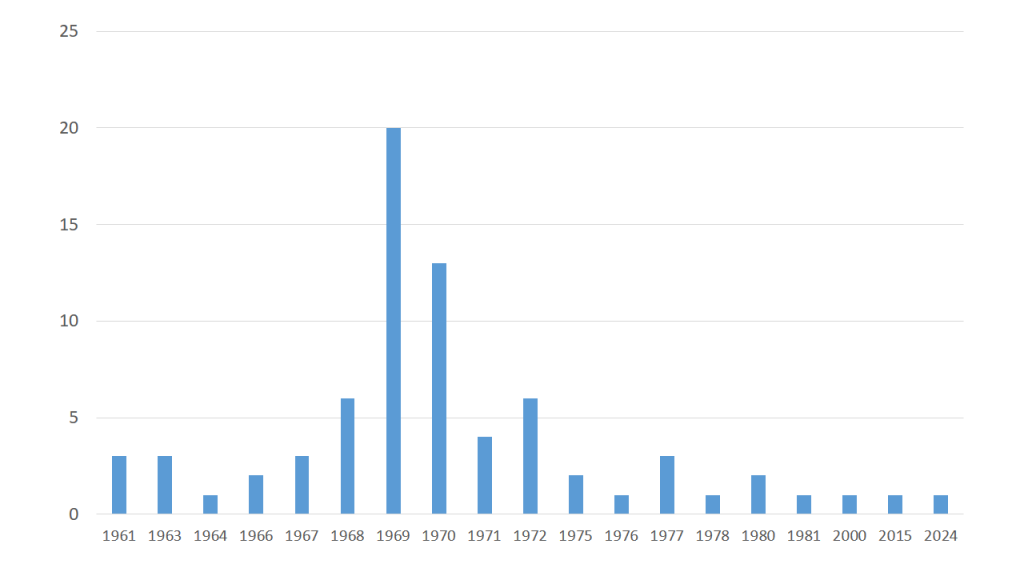
All data gathered on the dates of production of lunar globes at the GM in Vienna was combined with data on globes of the same typology in the collections of the Whipple Museum, the Royal Museums Greenwich and the Berlin State Library. The overall picture provided by the histogram of the production dates shows eloquently how their distribution is so closely tied with the development of the Apollo program – possibly reflecting the climax of public interest and, at least partially, the emergence of commercial ventures associated with this public enthusiasm (Figure 1).

But at the same time commercial copies were being produced following the demand of space enthusiasts – mainly used in popularization, teaching and representing the prowess and success of the US space program – other globes of the Moon were instrumental in research and exploration, sometimes working as physical aids in the production of maps, in other instances as tools in the preparation of lunar missions (Figure 2).
References
[1] – Irmgard Harrer, Alfred Schmidt, Thomas Zauner (eds.), The Austrian National Library (Munich/London/New York: Prestel Verlag, 2015), pp. 69-75. The old, and sumptuous, Habsburg Imperial Court Library (The State Hall), the Literature Museum, the Papyrus Museum and the Esperanto Museum are the remaining four museums housed at the Austrian National Library.
[2] – Jan Mokre,”Lunar and planetary globes in the holdings of the Austrian National Library’s Globe Museum”, 26th International Cartographic Conference (Dresden, 25-30 August 2013).
[3] – Heide Wohlschläger, “The Rudolf Schmidt Globe Collection”, Globe Studies Special Edition (2024), pp. 84-85. The 1961 Soviet lunar globe copy of the GM is identified by inventory number GL. 159.